

Most optimisation programmes are built on behaviour data: where users clicked, how far they scrolled, where they dropped off. But behaviour data tells you what happened - and by then, they've already gone.
Jellyfish, a global digital marketing and experience optimisation agency with over 1,600 people across 30 offices in 22 countries, has been using EyeQuant to act earlier, and this since 2013. Today, the team runs over 300 EyeQuant analyses a year.
The challenge
Jellyfish runs experience optimisation programmes at scale for some of the world's most complex brands. Their work combines quantitative data to identify opportunities with qualitative research to understand user behaviour. But there's a third dimension that analytics alone doesn't capture: what users actually see before they click anything.
"In addition to understanding how users behave, it's important to know how they perceive your website or your competitor's site," says Fabien Caublot, Customer Experience Director and Innovation Lead. "EyeQuant has been super useful for that."
The other challenge is time. Traditional eye-tracking means recruiting participants, running sessions, and waiting for results - none of which fits the pace of agency work.
A real eye-tracking study would probably be 30–40 hours for something polished and client-facing. With EyeQuant it's instant.
"You don't have to recruit real people, get them in a room, and run an actual eye-tracking study - which takes time and includes a lot of bias," says Fabien. "A real eye-tracking study would probably be 30–40 hours for something polished and client-facing. With EyeQuant it's instant. The convenience is definitely the number one thing people welcome."
How it works
EyeQuant sits at the start of Jellyfish's default audit process — a fast first layer of visual analysis before heatmapping, user testing, and qualitative research are layered on top.
The team uses it at three stages: during UX audits to surface issues quickly without live site access; during client pitches to demonstrate problems and validate proposed solutions before any code is written; and during design validation to confirm that changes are moving in the right direction before going to A/B test.
Just saying 'you should reduce the amount of text' is sometimes not powerful enough but showing a heatmap that demonstrates the cognitive load on that area — backed by real eye-tracking data — is extra powerful.
The clarity score is particularly powerful for client conversations.
"Just saying 'you should reduce the amount of text' is sometimes not powerful enough," says Fabien. "But showing a heatmap that demonstrates the cognitive load on that area — backed by real eye-tracking data — is extra powerful."
“And critically, all of this happens before a page goes live."
The IcyHot pitch
The clearest example came during a pitch for IcyHot, a muscle pain relief brand. Jellyfish were asked to assess a series of blog pages — with no platform access, no live data, and no ability to deploy tools.
"The key thing to remember is that this was a proposal," says Fabien. "All we have is what the client shows us from the front end."
Using EyeQuant, the team analysed the existing pages and identified that key product information lacked visual prominence, the page structure was diluting the core message, and CTAs weren't getting the attention they needed.
Jellyfish then brought together their UX, creative, copy, and SEO teams to redesign the page in Figma — improving hierarchy, strengthening messaging, and adding a sticky CTA. They ran the redesign back through EyeQuant. All three scores — measured on a 0–100 scale benchmarked against thousands of pages — showed the original design was underperforming across the board. The redesign changed that:
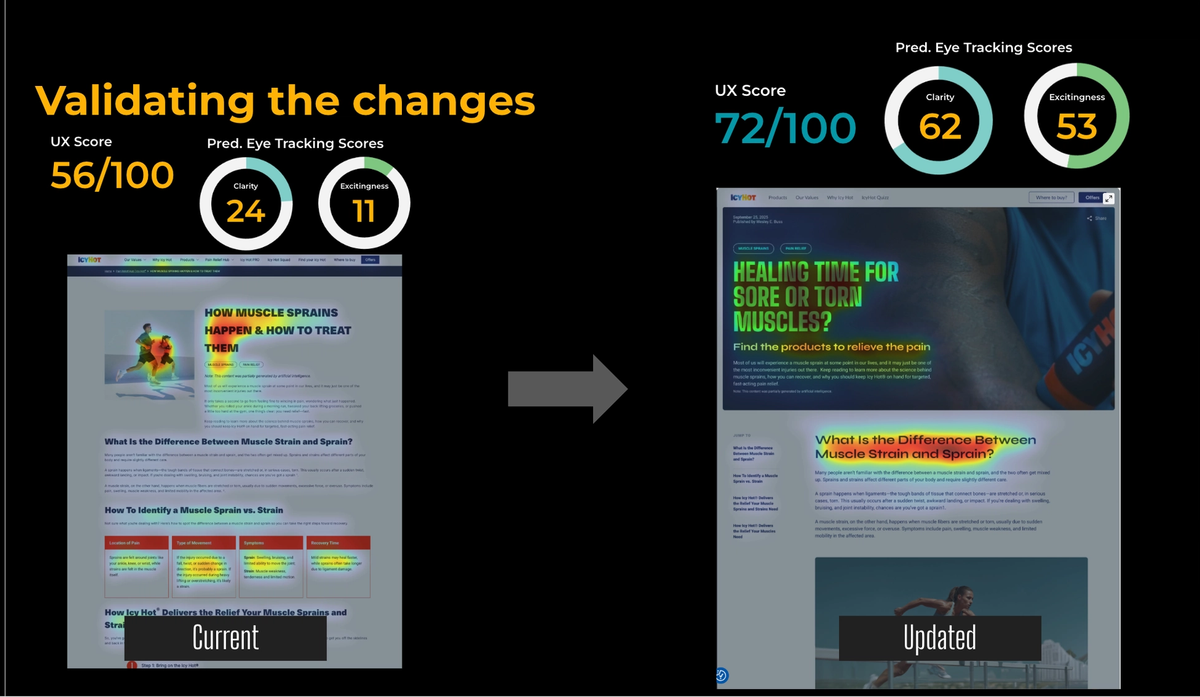
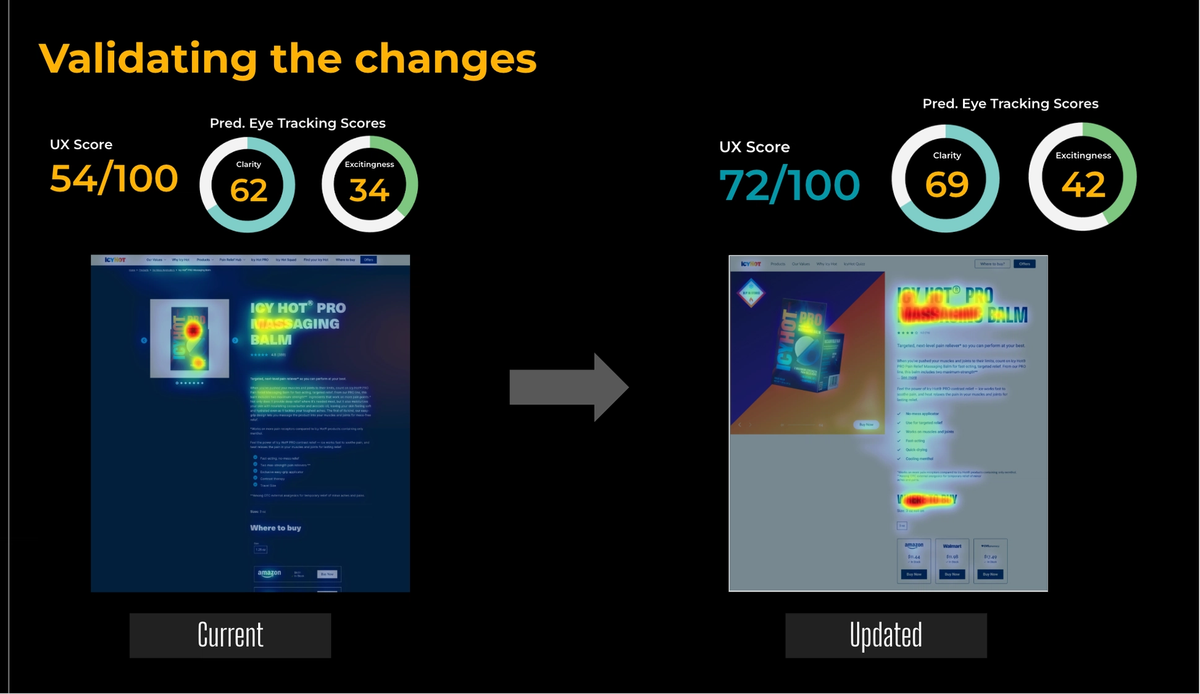
"We were able to validate those changes and show the value of our services before we even had access to the data," says Fabien. The work made an impression — and opened the door to a broader relationship, including Jellyfish's AI tools and ongoing analytics support.
The impact
For Jellyfish, EyeQuant's value shows up consistently across three areas:
- Speed — visual audits that would previously take 30–40 hours of coordination now happen in minutes, making EyeQuant viable even for unpaid pitch work.
- Credibility — attention maps turn subjective design debates into evidence-backed conversations, shifting discussions from "I think" to "the data shows."
- Earlier validation — proposed improvements can be tested before implementation, giving clients confidence before any development work begins.
This means fewer wasted iterations, stronger client conversations, and design decisions grounded in evidence — not opinion.

“A real eye-tracking study would probably be 30–40 hours for something polished and client-facing. With EyeQuant it's instant. The convenience is definitely the number one thing people welcome”
Fabien Caublot
CX Director
Ready to see results like these?