

From "I think" to "the data shows": how Tinuiti uses EyeQuant to take the guesswork out of creative decisions
Getting users to a page is only half the job. What happens next is where most campaigns win or lose - and it usually comes down to attention.
According to the Association of National Advertisers, less than half of every dollar spent on programmatic advertising effectively reaches consumers - and wasted ad spend has surged 34% in just two years, hitting $26.8 billion. With average landing page conversion rates sitting at just 2–4% across industries, the margin for error is thin.
The CRO team at Tinuiti - one of the largest independent digital marketing agencies in the US - manages millions in media spend across hundreds of landing pages for major brands like Etsy and Sony. At that scale, every design decision matters.
Their challenge: how do you make those decisions quickly, confidently and without endless internal debate?
The challenge
Tinuiti's clients invest heavily in paid traffic. A landing page that fails to convert doesn't just underperform, it wastes the entire media budget behind it.
The team had no shortage of optimisation ideas. The harder problem was subjectivity: design reviews would spiral into debates about layout, hierarchy, and messaging, with no objective way to settle them.
“The biggest lesson I've learned in CRO is that attention is the biggest driver - and it's often overlooked. Brands spend so much time and money getting users to the site, but they forget about what happens once those users land,” says Spencer Gray, CRO Program Manager.
They needed a way to see what users would actually notice and without waiting weeks for test results.
The solution
Tinuiti integrated EyeQuant across its optimisation process, using it both as an analysis tool and as a way to communicate insights clearly with clients.
“EyeQuant is usually my first stop before I look at analytics or behavioural tools. It sets the baseline for understanding how a page's visual hierarchy is working.”
“EyeQuant is usually my first stop before I look at analytics or behavioural tools. It sets the baseline for understanding how a page's visual hierarchy is working”, adds Spencer.
Attention and perception maps show the team exactly what users notice in the first few seconds - which elements dominate, which get ignored and whether the call-to-action is actually visible.
This helps reveal common issues such as: dominant imagery pulling attention away from key messages, calls-to-action that lack visibility and value propositions overpowering the rest of the page. These patterns often explain why a page struggles to convert.
For Theresa Farr, another member of the CRO team, the tool is embedded in her workflow at several key stages.
She explains, “During the pitch, it helps us move the conversation from intuition to evidence-based CRO. During an audit, it gives us an objective view of how a client's site performs visually compared with competitors. And during the design sprint, it acts as a final quality check before anything goes live.”
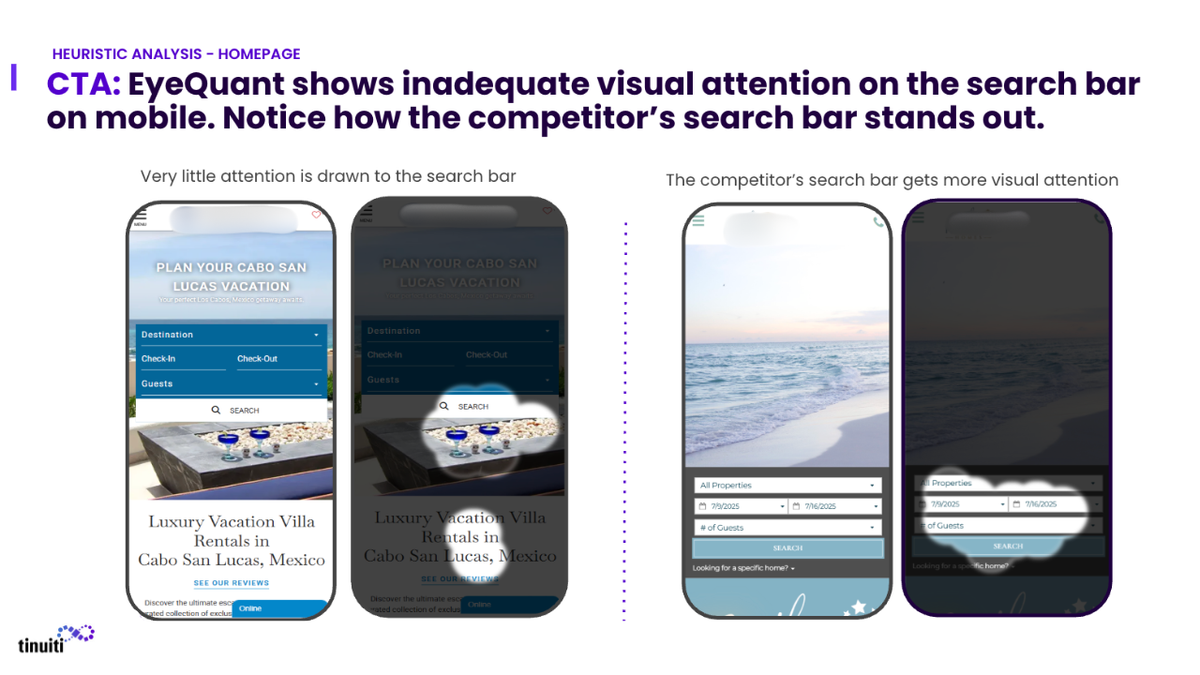
The biggest shift is in how decisions get made - turning "I think the CTA is too low" into "here's where user attention actually lands."
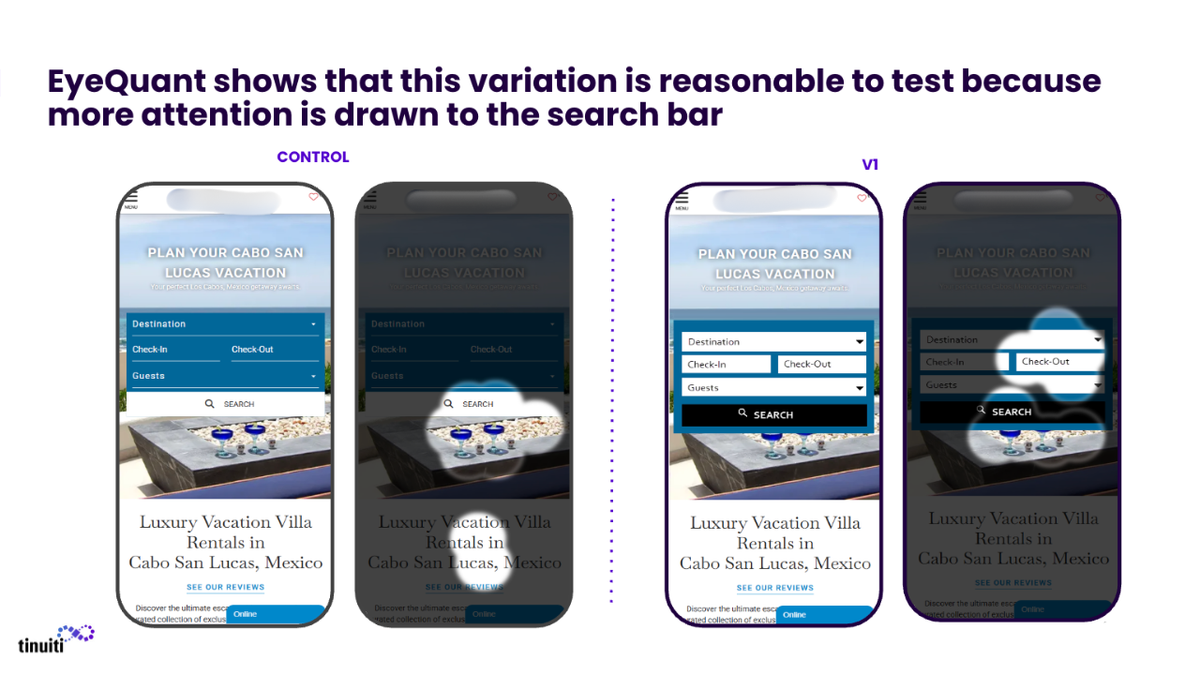
“EyeQuant transforms 'I think' into 'the data shows allowing us to settle debates quickly and secure client buy-in.”
“EyeQuant helps me eliminate subjectivity in the design process. It transforms 'I think' into 'the data shows,' allowing us to settle debates quickly and secure client buy-in with confidence”, she says.
“It serves as a bridge between design and data. By using heatmaps to illustrate cognitive load and attention flow, we can move beyond opinions and help clients understand the reasoning behind our recommendations.”
She adds, “Unlike traditional user testing, which can take days to coordinate, EyeQuant provides objective visibility into user attention in seconds. That immediacy allows us to iterate faster and present findings that are as intuitive as they are evidence-based.”
The results
In one recent project for a pest control client, EyeQuant revealed that users’ attention was already concentrating heavily on the value proposition above the fold.
Rather than redesign the layout or shift attention elsewhere, the team used that insight to strengthen the messaging in the area users were already focused on - rewriting the headline to emphasise year-round protection ahead of the colder months.
The results spoke for themselves, even entering the client's off-season:
- 8% lift in total phone call volume
- 56% increase in form completions
“Clients suddenly see their site in a way they've never seen before. It shifts the conversation from subjective design opinions to real insight about user attention,” explains Theresa.
For Tinuiti, EyeQuant has become the bridge between design instinct and data-backed decisions - letting the team move faster, align clients sooner, and build experiences that work the way users actually see them.

“Unlike traditional user testing, which can take days to coordinate, EyeQuant provides objective visibility into user attention in seconds. That immediacy allows us to iterate faster and present findings that are as intuitive as they are evidence-based.”
Theresa Farr
CRO Program Manager
Ready to see results like these?